
Hi, I'm Leandro C. I live in Arizona. Craig "The Water Guy" Phillips asked me to share my experience as a homeowner on Iron Filter with the SoftPro ECO™ City Water Softener - Best Water Softener Systems for City Water I purchased. This is how my adventures played out. I hope this helps you in your decision.
Installing a water softener wasn't something I ever thought I'd do myself, but here I am six months later, wondering why I waited so long. My old system had been limping along for years, leaving white spots on everything and making our skin feel like sandpaper after showers. When it finally gave up completely last spring, I faced a choice: pay a fortune for professional installation of a basic unit, or take the plunge with something better and handle it myself.
What drove me to finally replace my failing water treatment system?
Living in Arizona means dealing with some of the hardest water in the country. Our municipal supply tests at around 18 grains per gallon of hardness - that's considered "very hard" by any standard. For years, I watched our appliances suffer, our glassware develop permanent clouding, and our water heater struggle under mineral buildup.
The breaking point came when our 12-year-old water softener started cycling constantly, wasting salt and water while barely making a dent in the hardness levels. I tested the water coming out at 15 grains - essentially no improvement from the incoming supply. Between the wasted salt, rising utility bills from an overworked water heater, and the constant frustration of dealing with hard water effects, I calculated we were losing about $150 monthly.

The Problem: Arizona's Brutal Water Conditions
Did you know that Arizona consistently ranks among the top five states for water hardness?
The geology here creates perfect conditions for dissolved calcium and magnesium - the primary culprits behind hard water problems. Our area pulls water from both the Colorado River and underground aquifers that have been filtering through limestone and gypsum deposits for centuries.
The impact on daily life was impossible to ignore. Our dishwasher, despite being only three years old, had mineral buildup so severe that dishes came out cloudier than when they went in. The shower heads needed monthly CLR treatments just to maintain decent water pressure. Most frustrating was the effect on our skin and hair - my wife started buying expensive moisturizers to combat the dryness, and our teenage daughter constantly complained about her hair feeling "weird" after washing.
I measured our incoming water at 18.5 grains per gallon using a TDS meter and hardness test strips. For context, anything over 10.5 grains is considered "very hard" by the Water Quality Association. We were dealing with nearly double that threshold. The calcium carbonate equivalent was around 316 parts per million - no wonder our appliances were struggling.

Research Phase: Understanding What I Really Needed
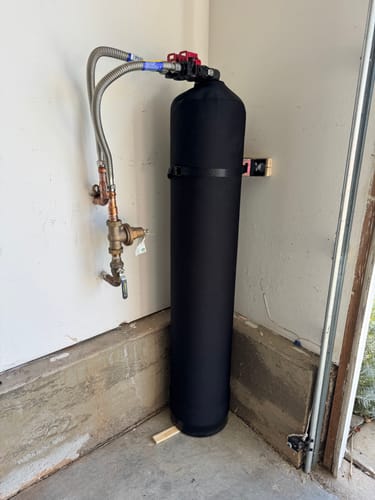
After dealing with the frustration of an inadequate system for years, I wasn't going to make the same mistake twice. I spent weeks researching different technologies, capacity requirements, and efficiency ratings. The key factors that mattered most for our situation were regeneration efficiency, salt usage, water waste during backwashing, and the ability to handle our specific hardness levels consistently.
Traditional timer-based systems immediately went off my list - they waste too much water and salt by regenerating on schedule regardless of actual usage. I needed something with demand-initiated regeneration that would only cycle when necessary. Flow rate was another critical consideration since we're a family of four with typical morning rush patterns.
The SoftPro ECO caught my attention because of its upflow regeneration design and high-capacity fine mesh resin. Unlike traditional downflow systems that can create channeling and uneven resin contact, the upflow design ensures better efficiency and longer resin life. The system is rated for up to 64,000 grains of hardness removal, which translates to about 12-14 days between regenerations for our household with 18-grain water.

Installation Experience: Easier Than Expected
I'll be honest - I was nervous about tackling this installation myself. My plumbing experience was limited to basic repairs and fixture replacements. But the existing connections were standard 1-inch copper, and I had enough space in our utility room for the bypass valve configuration.
The system arrived in excellent condition, packaged better than most appliances I've received. Everything was clearly labeled, and the installation manual was surprisingly detailed without being overwhelming. The control head came pre-programmed with default settings, though I knew I'd need to adjust for our specific water conditions.
The actual installation took about four hours, including time to make two trips to Home Depot for fittings I should have bought beforehand. The most challenging part was positioning the 64,000-grain tank - it's substantial when filled with resin and water, probably 200 pounds. I recruited my neighbor to help maneuver it into final position.
Connecting the bypass valve required some careful measuring to ensure proper alignment, but the compression fittings made the process straightforward. The drain line connection was simple - just a matter of running tubing to our utility sink with the proper air gap. Power connection was basic 110V to a nearby outlet.
First Month Performance: Immediate Improvements

The difference was noticeable within 24 hours of the first regeneration cycle. I tested the treated water at 1 grain per gallon - finally achieving the "soft" classification. More importantly, the practical improvements were obvious throughout the house.
Shower experience improved dramatically. The "slippery" feeling that some people associate with soft water took a few days to get used to, but our skin stopped feeling tight and dry immediately. My wife noticed the difference in her hair within a week - it felt smoother and required less conditioner.
Dishwasher performance was like getting a new appliance. Glasses came out crystal clear for the first time in years. I reduced our rinse aid usage by half and eliminated the need for special hard water detergents. Even our everyday dishes looked noticeably cleaner and spot-free.
The system's first regeneration cycle occurred after 11 days of normal usage - exactly in line with my calculations based on our household size and water hardness. The process ran quietly during the programmed 2 AM cycle, using approximately 2.5 pounds of salt and 35 gallons of water for backwashing.
Technical Performance: Six Months of Real-World Data
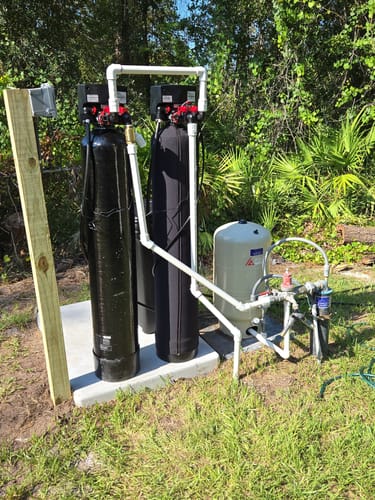
After six months of operation, I've tracked the system's performance closely. Average regeneration frequency has settled at every 12-13 days with our normal usage patterns. During higher usage periods (house guests, extra laundry), it adjusts appropriately and might cycle every 9-10 days.
Salt consumption averages 25-30 pounds monthly, significantly less than our old system that was using 40 pounds while delivering poor results. I attribute this efficiency to the upflow regeneration design and the system's ability to calculate actual resin exhaustion rather than guessing based on time intervals.
Water waste during regeneration has been minimal compared to our previous system. Each cycle uses approximately 35 gallons for backwashing and rinsing - about what a single load of laundry consumes. The entire process completes in under 90 minutes, and I've never noticed pressure drops or service interruptions.
The fine mesh resin appears to be maintaining its effectiveness well. I test the treated water monthly and consistently measure 0-1 grain per gallon hardness. Even immediately before regeneration cycles, when the resin is most exhausted, hardness rarely exceeds 2 grains per gallon.
Daily Living Impact: Beyond Just Soft Water
The improvements extend far beyond what I initially expected. Our water heater efficiency increased noticeably - the unit runs shorter cycles and maintains temperature more consistently. I cleaned out significant mineral buildup during a recent flush, and new deposits are minimal.
Soap and detergent usage dropped across the board. We're using about 25% less dish soap, laundry detergent, and body wash to achieve better results. The water feels "wetter" if that makes sense - it rinses soap and shampoo more effectively than before.
Cleaning routines simplified significantly. Bathroom fixtures stay cleaner longer, and when they do need attention, softpro water softener for city water standard cleaners work effectively instead of requiring harsh lime-scale removers. Our glass shower doors look presentable with weekly cleaning instead of constant maintenance.
Even small appliances benefited. Our coffee maker stopped requiring monthly descaling treatments. The ice maker in our refrigerator produces clearer cubes without the cloudy appearance we'd accepted as normal. Steam irons work better and last longer without mineral clogging.
Operational Costs: Real Numbers After Six Months
Monthly salt costs average $12-15, purchasing standard solar salt pellets from Home Depot. I buy 40-pound bags for around $5-6 each when they're on sale. The system holds about 200 pounds in the brine tank, so refilling every 6-8 weeks maintains proper levels.
Water consumption for regeneration adds roughly $8-10 monthly to our utility bill, based on local rates of $0.008 per gallon. This includes both the backwash water and the additional soft water used to prepare brine solutions.
Electricity usage is negligible - the control head draws minimal power except during regeneration cycles. I estimate less than $3 monthly in additional electrical costs.
Total operating costs run about $25-30 monthly, compared to $45-50 with our previous inefficient system. Factor in reduced soap usage, fewer cleaning products, and decreased appliance maintenance, and the system pays for itself quickly.
Final Assessment: Worth the Investment
Six months in, this system has exceeded my expectations in almost every way. The installation was manageable for someone with basic DIY skills, the performance has been consistent and efficient, and the quality-of-life improvements justify the investment.
Would I choose the SoftPro ECO again?
Absolutely. The upflow regeneration technology, efficient salt usage, and robust construction make it a significant upgrade from conventional systems. For households dealing with very hard water like ours, the capacity and efficiency prove their worth daily.
The system isn't perfect - the control head interface could be more intuitive, and the tank takes up considerable space. But these minor inconveniences pale compared to the benefits of consistent, efficient soft water production.
For anyone dealing with hard water frustrations, especially in challenging areas like Arizona, this system delivers the performance needed to make a real difference. The installation might seem intimidating initially, but the long-term benefits make it worthwhile.